Hannah Arendt - who viewed herself not as a philosopher but primarily as a political scientist - taught us, among other things, that the path to authoritarianism and totalitarian forms of government can open up whenever and wherever social classes disintegrate and transform into amorphous “masses”. This process usually coincides with upheavals in patterns of political representation and a loosening of the ties between citizens and parties, ultimately leading to the erosion of a political system that previously appeared stable and unshakable.
Typically, the far-right - whether “classic” or “alternative” - gains strength when the political system as a whole enters a crisis. This is especially true when the so-called bourgeois parties begin to “stagger” and “falter” - though this does not apply to parties traditionally classified as left (socialist or communist) or to those belonging to new political families that do not originate from the political landscape of the 18th and early 19th centuries.
Typically, the far-right - whether “classic” or “alternative” - gains strength when the political system as a whole enters a crisis. This is especially true when the so-called bourgeois parties begin to “stagger” and “falter” - though this does not apply to parties traditionally classified as left (socialist or communist) or to those belonging to new political families that do not originate from the political landscape of the 18th and early 19th centuries.


This is precisely what is happening today: in France, with the disintegration of the Republican party (the old so - called Gaullists); in Germany, with the self-destruction of the FDP - and now, perhaps, the Christian Democrats too; and in the United Kingdom, with the self-destruction of the Conservative Party. This happened also in Italy, with the shrinking of the Berlusconi-led heir to the traditional Italian Christian Democratic party, now being held hostage by parties to its right. Above all, it is occurring in the US, with the takeover of the “Grand Old Party” - the party of Lincoln, Nixon, and Reagan - by a postmodern amalgam of “populo-fascists” (völkisch) and techno-anarcho-capitalists (libertarians): the MAGA-Trumpists.
And when does the critical moment for the rise of “anti-systemic” forces arrive? It arrives when, under the influence of political catalysts, active, powerful and relatively large minorities take shape within politically inert masses and begin to act as an active mob - as Hannah Arendt writes. This was the lesson learned from the emergence of fascism and Nazism in interwar Europe. These political catalysts may not always be avowed fascists, far-right figures, or totalitarians; instead, they may profess allegiance to a wide range of ideologies - from the (ultra-)liberal to the motley array of “pro people” and populist movements, from “conservative” defenders of “tradition” to “moderate centrist” or “uncompromisingly left” factions.
And when does the critical moment for the rise of “anti-systemic” forces arrive? It arrives when, under the influence of political catalysts, active, powerful and relatively large minorities take shape within politically inert masses and begin to act as an active mob - as Hannah Arendt writes. This was the lesson learned from the emergence of fascism and Nazism in interwar Europe. These political catalysts may not always be avowed fascists, far-right figures, or totalitarians; instead, they may profess allegiance to a wide range of ideologies - from the (ultra-)liberal to the motley array of “pro people” and populist movements, from “conservative” defenders of “tradition” to “moderate centrist” or “uncompromisingly left” factions.
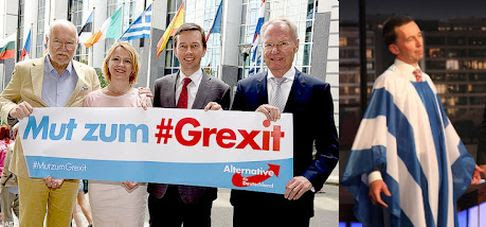
Henkel and Lucke, the founding fathers of the German AfD, were examples of such anti-state, anti-EU liberals, while their associate Gauland represented the “conservative traditionalist” type.
In our own time, such moments and corresponding catalysts have emerged across European countries. In Germany, the phenomenon took on its current form during the Eurozone financial crisis with the rise of the AfD. It gained momentum during the latter part of the Merkel era through “anti-establishment” mob-like movements such as Pegida (“Patriotic Europeans against the Islamisation of the West”). During the pandemic, both in Europe and the US, American-style anti-state (anarcho-)liberalism - or libertarianism - converged with far-right populism within the anti-vaccination movement. Furthermore, following Putin’s invasion of Ukraine (2022) and the severing of Germany’s energy ties to the Russian fossil-fuel empire, German “populist-fascism” adopted a pseudo-pacifist - yet in reality, pro-Putin - guise. Unlike the interwar period, however, the phenomenon now encounters political counterweights and resistance from civil society and from political forces capable of looking beyond the immediate horizon.
In our own time, such moments and corresponding catalysts have emerged across European countries. In Germany, the phenomenon took on its current form during the Eurozone financial crisis with the rise of the AfD. It gained momentum during the latter part of the Merkel era through “anti-establishment” mob-like movements such as Pegida (“Patriotic Europeans against the Islamisation of the West”). During the pandemic, both in Europe and the US, American-style anti-state (anarcho-)liberalism - or libertarianism - converged with far-right populism within the anti-vaccination movement. Furthermore, following Putin’s invasion of Ukraine (2022) and the severing of Germany’s energy ties to the Russian fossil-fuel empire, German “populist-fascism” adopted a pseudo-pacifist - yet in reality, pro-Putin - guise. Unlike the interwar period, however, the phenomenon now encounters political counterweights and resistance from civil society and from political forces capable of looking beyond the immediate horizon.
Ηowever, in our era - an age of digital publicity and so-called social networks - the communication and political agendas of key media players have become more powerful catalysts. This applies not only to major media outlets - both traditional and digital - but, above all, to agendas driven by network algorithms. In the German case, two factors weigh heavily: the media power of the American-German conglomerate Axel Springer SE (owning Bild, Welt, Politico, The Daily Telegraph, The Sunday Telegraph, Business Insider, and TV channels), and the overwhelming dominance of the AfD on social networks, aided by their algorithms.
Here in Greece, Golden Dawn - a group even more extreme than the AfD and avowedly Nazi - gained strength between 2010 and 2013 as a particularly violent manifestation of the ideologically and politically nebulous “anti-austerity movement”. Alongside its increasingly extreme radicalization and open criminal activity, its influence spread like an epidemic into significant—and even “respectable” - segments of Greek society. This continued until action was taken by parts of society that had not been “infected” and, crucially, by the robust defense mechanisms of democracy. Thus, we too learned this lesson the hard way here in Greece.
Here in Greece, Golden Dawn - a group even more extreme than the AfD and avowedly Nazi - gained strength between 2010 and 2013 as a particularly violent manifestation of the ideologically and politically nebulous “anti-austerity movement”. Alongside its increasingly extreme radicalization and open criminal activity, its influence spread like an epidemic into significant—and even “respectable” - segments of Greek society. This continued until action was taken by parts of society that had not been “infected” and, crucially, by the robust defense mechanisms of democracy. Thus, we too learned this lesson the hard way here in Greece.
A sustainable democracy is a defensive (or militant) democracy (wehrhafte Demokratie). The defining characteristic of a defensive democracy is that this form of government identifies in good time those who seek to destroy it. The capacity to resist and prevail is, first and foremost, essential at the level of institutions. Yet this is not enough. For “the liberal, secularized state” - a state with constitutionally enshrined freedoms and rights - “feeds from preconditions that it cannot itself guarantee” (Ernst-Wolfgang Böckenförde). Securing these preconditions in the “pre-political" realm - that is, within the mindsets, values, and mores of any given era (Sittlichkeit, in Hegel’s terms) - constitutes a fundamental arena of struggle for democracy.
There are times when the mechanisms for validating social values malfunction, and when inevitable conflicts - whether in the realm of moral, political, and economic mores or within the “system-colonized” sphere of everyday life (Habermas) - become distorted and veer away from objective reality. The economic and political (sub)systems, with their operational and performative autonomy, fail to respond adequately to stimuli from the “most true” reality - that is, the reality that exists externally to these systems, constituting their environment. For the systems of the economy and politics, the external environment comprises - alongside physical reality - what we term human nature or “inner nature”. There are eras when the internal systemic “languages” through which the economy and politics communicate with the outside world and perform their functions lose their interpretive capacity, become rigid, and fail to correctly translate incoming stimuli. These are eras of failure; this is when “system failure” occurs.
Due to the lopsided concentration of immense social, economic, and political power within tiny segments of society, irrationality and egoistic destructiveness gain the upper hand, rendering the polity ungovernable. This was understood even in their time by Plato and Aristotle - thinkers with oligarchic leanings, yet rationalists rigorous enough not to accept as an inescapable destiny the inherent self-destructive dynamic of oligarchic systems. Today, the most powerful apologists for oligarchy are irrational billionaire tech gurus. Some of them attempt to legitimize it by resorting to eschatology, accepting Armageddon as humanity’s fate and organizing an “End Times Fascism” (Naomi Klein / Astra Taylor). But from the actual consequences, a belated concern arises and provokes contradictory reactions. Where might lead the monstrously irrational delusion that technology can effectively and rationally control nature (both external and human)? Some rush headlong toward chaos, while others are now contemplating the emergency brake: today, even the creators of so-called artificial intelligence have come to wonder whether their creation will destroy humanity.
What happened, Messrs. Sam Altman, Dario Amodei, Elon Musk, and Co? A pact with the Devil? And did the Evil One manage to deceive you? Did he deceive you, too? You, who “imagine that you have risen to a level of human civilization that no one had reached before” (Max Weber)?
There are times when the mechanisms for validating social values malfunction, and when inevitable conflicts - whether in the realm of moral, political, and economic mores or within the “system-colonized” sphere of everyday life (Habermas) - become distorted and veer away from objective reality. The economic and political (sub)systems, with their operational and performative autonomy, fail to respond adequately to stimuli from the “most true” reality - that is, the reality that exists externally to these systems, constituting their environment. For the systems of the economy and politics, the external environment comprises - alongside physical reality - what we term human nature or “inner nature”. There are eras when the internal systemic “languages” through which the economy and politics communicate with the outside world and perform their functions lose their interpretive capacity, become rigid, and fail to correctly translate incoming stimuli. These are eras of failure; this is when “system failure” occurs.
Due to the lopsided concentration of immense social, economic, and political power within tiny segments of society, irrationality and egoistic destructiveness gain the upper hand, rendering the polity ungovernable. This was understood even in their time by Plato and Aristotle - thinkers with oligarchic leanings, yet rationalists rigorous enough not to accept as an inescapable destiny the inherent self-destructive dynamic of oligarchic systems. Today, the most powerful apologists for oligarchy are irrational billionaire tech gurus. Some of them attempt to legitimize it by resorting to eschatology, accepting Armageddon as humanity’s fate and organizing an “End Times Fascism” (Naomi Klein / Astra Taylor). But from the actual consequences, a belated concern arises and provokes contradictory reactions. Where might lead the monstrously irrational delusion that technology can effectively and rationally control nature (both external and human)? Some rush headlong toward chaos, while others are now contemplating the emergency brake: today, even the creators of so-called artificial intelligence have come to wonder whether their creation will destroy humanity.
What happened, Messrs. Sam Altman, Dario Amodei, Elon Musk, and Co? A pact with the Devil? And did the Evil One manage to deceive you? Did he deceive you, too? You, who “imagine that you have risen to a level of human civilization that no one had reached before” (Max Weber)?

Faustian medieval specters - along with the terrors of early modernity and of the dawn of the industrial age, when the specter of the “Modern Prometheus” (Frankenstein) and the “Last Man” (Mary Shelley, 1797–1851) first struck fear into people - are returning. They reappear now as living, tangible realities in an era supposedly characterized by maximum liberation from the “realm of necessity”. It is an age in which, we are told, capital accumulates by drawing solely upon the intangible; what truly counts and holds value (even market value!) are immaterial bits, rather than particles of matter or quanta of energy.
True liberal democracy is a political system built gradually, in tandem with the rising material security of vast populations across large parts of the globe. The other name of this material security is the welfare state, in regions defined by peace and freedom. Instead of this, we are currently living through an era of profound in-security: everywhere we see arsonists of social cohesion pouring gasoline on the fire, major and protracted wars, and geopolitical destabilization; above all, we witness a climate crisis that surpasses all previous predictions regarding its severity and rate of acceleration. Now, we are also consumed by the fear that a technological creation of humanity might destroy humanity itself.
True liberal democracy is a political system built gradually, in tandem with the rising material security of vast populations across large parts of the globe. The other name of this material security is the welfare state, in regions defined by peace and freedom. Instead of this, we are currently living through an era of profound in-security: everywhere we see arsonists of social cohesion pouring gasoline on the fire, major and protracted wars, and geopolitical destabilization; above all, we witness a climate crisis that surpasses all previous predictions regarding its severity and rate of acceleration. Now, we are also consumed by the fear that a technological creation of humanity might destroy humanity itself.
Under these new conditions, liberal democracy - the only form of government truly deserving of the name - cannot be taken for granted as secure, and the struggle to safeguard it becomes far more demanding.
George Ritzoulis




















Δεν υπάρχουν σχόλια:
Δημοσίευση σχολίου